Context
For around twenty years, CRA-W has contributed to monitoring crop growing conditions and forecasting the yields of the main crops in Belgium within the framework of the BCGMS (Belgian Crop Growth Monitoring System). This work combines meteorological data, satellite observations, field data and crop growth models, and notably supports the agrometeorological bulletins published three times a year by CRA-W in partnership with RMI and VITO.
To facilitate the calculation of indicators and yield forecasting, a first statistical toolbox was developed in 2005. Still in use today, it had gradually become obsolete from an IT perspective and no longer fully met current needs, particularly in terms of visualisation, indicator analysis and process automation.
The BCGMStat project therefore aims to modernise this working environment and better integrate it into the existing BCGMS ecosystem.
Objectives
The main objective of BCGMStat is to develop a modern tool to facilitate and accelerate indicator analysis and crop yield forecasting.
More specifically, the project aims to:
- modernise the statistical toolbox used for yield forecasting;
- directly connect the tool to the BCGMS indicator database, including meteorological, satellite-based and crop-specific indicators;
- develop graphical functionalities to better explore, compare and interpret indicators and forecasting results;
- further automate the different steps of the forecasting process;
- integrate the routine execution of the WOFOST crop growth model at a 10-day time step;
- enable the use of selected WOFOST outputs, such as simulated biomass yields, storage-organ yields and yield gaps, notably through the BCGMSweb platform.
Implementation
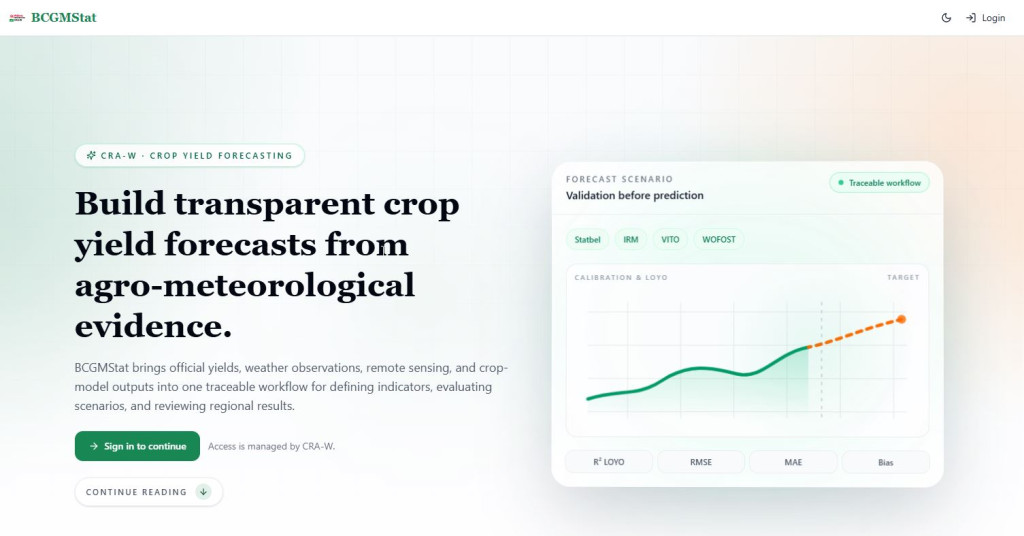
The project began with a functional analysis of the former toolbox and the identification of the functionalities to be retained, modernised or newly developed. A new application was then designed to centralise data access, statistical analysis and visualisation.
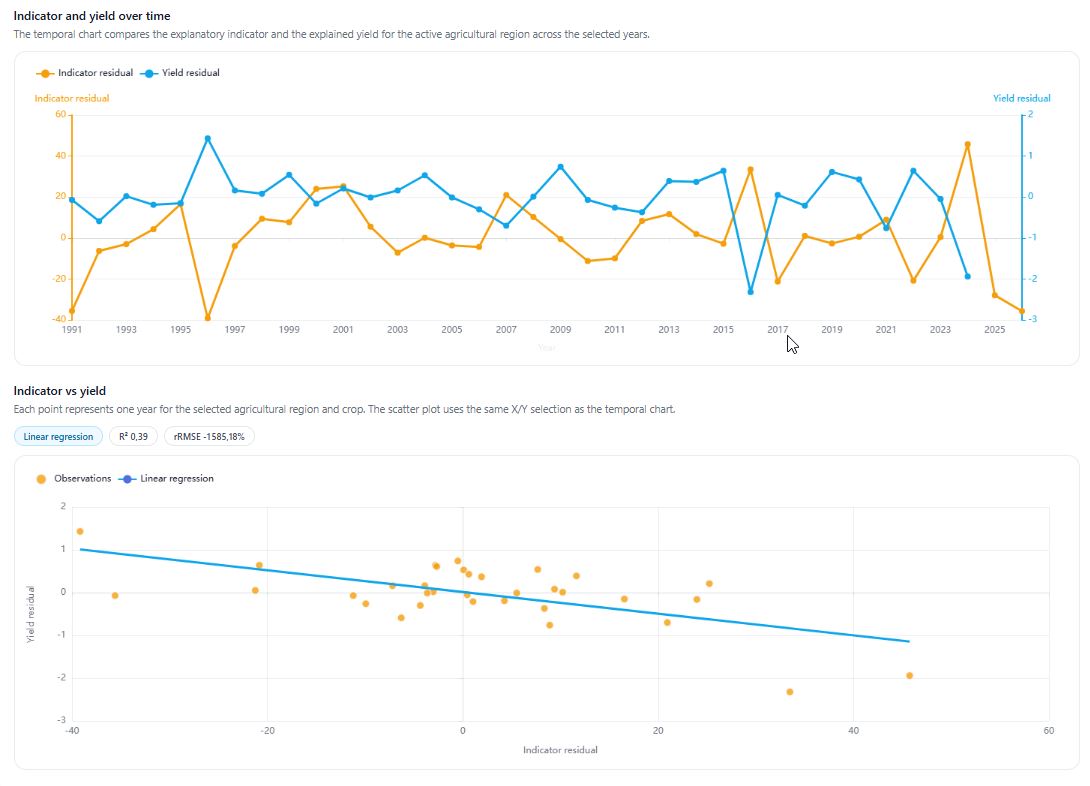
The application is directly connected to the data used within BCGMS. It allows different indicator time series to be generated and analysed, their relationships with observed yields to be investigated, and their use in forecasting models to be facilitated.
In parallel, the satellite data processing chains were redesigned to produce harmonised time series based on PROBA-V and Sentinel-3 data. These processing chains make it possible to derive indicators describing vegetation status and dynamics at the agricultural-region level. At this stage, NDVI is the main satellite-derived indicator integrated into the system, but the approach has been designed to accommodate additional indices and biophysical variables in the future.
The WOFOST crop growth model was also integrated to enable its routine execution and the use of its main outputs within the BCGMS system.
Finally, the different modules and processing chains were tested using available historical data in order to verify their proper functioning and strengthen the current indicator production and yield forecasting workflow.
Expected results
The BCGMStat project has led to the development of a new IT environment designed to modernise and facilitate the yield forecasting process implemented within BCGMS.
The tool centralises access to the different indicator time series and enables their visualisation, statistical analysis and evaluation for use in forecasting models. Direct integration with the BCGMS databases reduces manual data handling and improves the reproducibility of the analyses.
The project has also made it possible to integrate the execution of the WOFOST crop growth model and to prepare the use of selected model outputs within the BCGMS environment.
Beyond the technical modernisation, BCGMStat is primarily intended to reduce the time devoted to data preparation and processing, thereby allowing more time to be dedicated to the analysis and interpretation of results.
Funding
BELSPO, DISSUP project
Team