Context
The weather plays a central role in many decisions in agriculture. By cross-referencing real-time observations from connected weather stations with weather forecasts, it is possible to estimate crop development and calculate the risks associated with insect pests and pathogenic fungi.
Objectives
With the Winter Wheat Decision Support System (DSS), the CRA-W provides farmers and advisers with a decision-support tool available free of charge on the Agromet.be. platform. This tool assists with the management of winter wheat cultivation, but also supports researchers in modelling and, consequently, in gaining a deeper understanding of the biological processes involved. The Winter Wheat DSS encourages users to monitor their fields at the right time, informs them about certain plant health risks and promotes the responsible use of plant protection products.
How the tool works
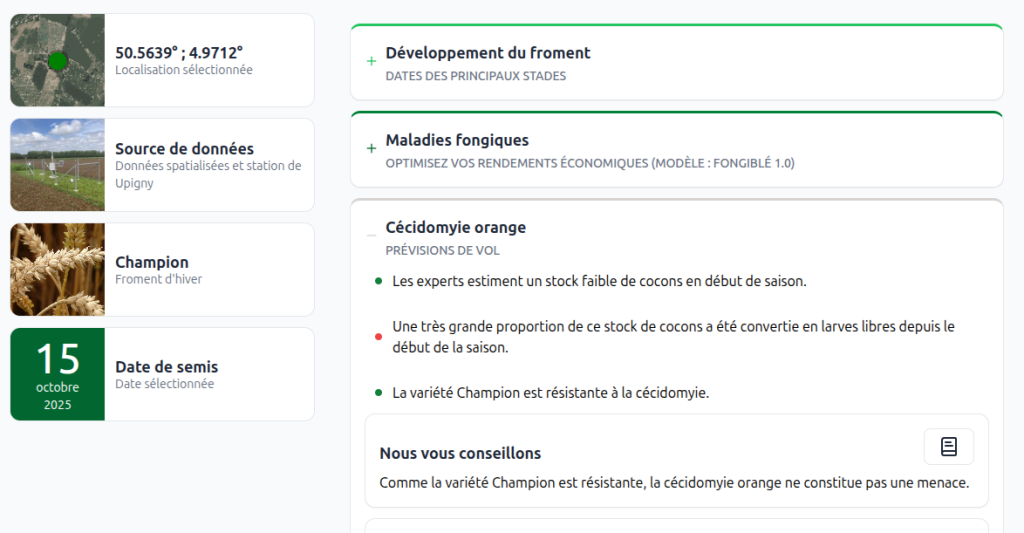
The Winter Wheat DSS tool allows users to select the location of their field on an interactive map and asks them to enter the sowing date and the wheat variety used. Based on this information and weather data, models are used to calculate weather risks.
The DSS comprises three modules:
• PhénoBlé estimates the crop’s stages of development. These phenological stages are those of the BBCH scale. Their calculation takes into account the temperature sums since sowing, as well as the photoperiod and vernalisation.
• FongiBlé recommends the best fungicide treatment programme based on the susceptibility of the sown wheat variety and the weather-related risks of the development of the four main fungal diseases: septoria leaf spot, yellow rust, brown rust and fusarium head blight.
• CéciBlé calculates the emergence dates of the orange cecidomyia, a small fly that lays its eggs in the ears, and whose larvae feed directly on the developing grain. The model also estimates the likely intensity of emergence and determines when weather conditions are favourable for adult flight and egg-laying.
Each of these models is the result of many years of research and numerous field observations and experiments carried out at CRA-W and by its partners.

The orange wheat blossom midge’s flight periods coincide with the period during which wheat is susceptible (between the emergence of ears and mid-flowering).
Results
The PhénoBlé, FongiBlé and CéciBlé models have been merged to form the Winter Wheat DSS, as part of an integrated approach. Consequently, the growth stages calculated by PhénoBlé are used to estimate risks according to the crop’s growth stage in the FongiBlé and CéciBlé models. The tool’s graphical interface now allows for simple, one-off input of parameters for all three models. Users have already carried out over 5,000 simulations using these models.
Partners
CePiCOP, Gembloux Agro-Bio tech (ULiège)
Funding
CRA-W
Publications
Find out more about the orange wheat blossom midge