An untargeted metabolomics and high-resolution mass spectrometry study conducted at CRA-W reveals extensive structural diversity among steroidal glycoalkaloids (SGAs) in potato leaves and provides new insights into their structural diversification and potential biosynthetic relationships.
A new study published in Potato Research investigates the diversity of steroidal glycoalkaloids (SGAs) occurring in potato (Solanum tuberosum) leaves.
These specialized metabolites are involved, among other functions, in plant chemical defence. Research on potato SGAs has historically focused predominantly on two major compounds, α-solanine and α-chaconine, both derived from the solanidine aglycone. The results obtained at CRA-W indicate, however, that the potato leaf SGA metabolome is considerably more diverse.
More than 30 glycoalkaloids revealed by UHPLC-QTOF-MS/MS
Using untargeted metabolomics based on ultra-high-performance liquid chromatography coupled to high-resolution quadrupole time-of-flight tandem mass spectrometry (UHPLC-QTOF-MS/MS), leaf metabolite profiles from three potato cultivars — Lady Rosetta, Charlotte and Bintje — were compared.
Accurate mass measurements, chromatographic retention behaviour and MS/MS fragmentation spectra enabled the detection and annotation of more than 30 triglycosylated alkaloids, differing in both their steroidal aglycone structures and glycosylation topologies.
α-Solanine, α-chaconine and α-solamargine were confirmed using authentic analytical standards (MSI level 1), while the remaining proposed structures represent putative annotations based on high-resolution mass spectrometric evidence (MSI levels 2–3).
From solanidine to solaverols: an oxidation continuum
One of the main findings of the study is the identification of four major SGA families associated with different steroidal aglycones:
solanidine (m/z 398) → solasodine (m/z 414) → solaverol A (m/z 430) → solaverol B (m/z 446).
These compounds constitute a coherent homologous series differing through successive oxygen additions. This pattern suggests an oxidation continuum during late stages of steroidal glycoalkaloid biosynthesis, extending beyond the classical model centred predominantly on α-solanine and α-chaconine.
The detection of SGAs consistent with solasodine- and solaverol-type aglycones therefore provides new evidence connecting several steroidal alkaloid families that remain insufficiently integrated into current models of potato SGA metabolism.
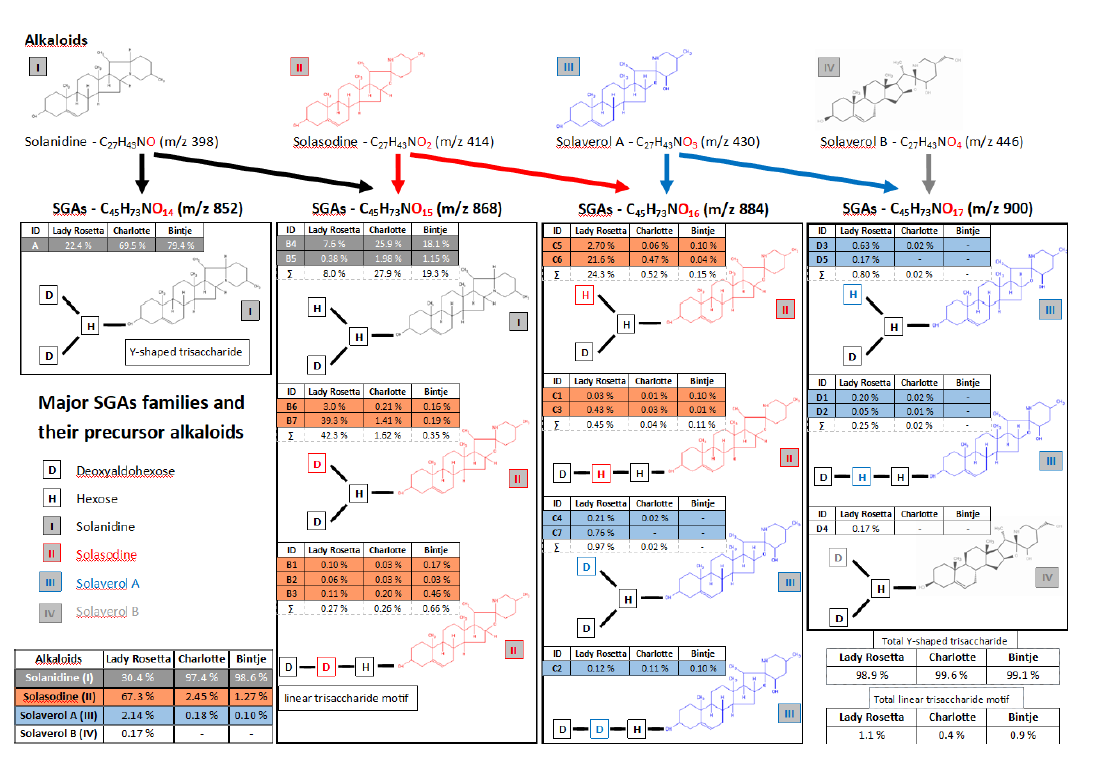
Low-abundance unsaturated forms reveal additional metabolic complexity
Untargeted analysis also reproducibly detected several low-abundance SGA families characterized by aglycone-related ions at m/z 396, 412 and 428.
These signals are compatible with partially unsaturated and/or oxidized steroidal alkaloid backbones, including structures related to solanid-16-en-type compounds. Their two-hydrogen difference from the corresponding canonical series suggests that additional dehydrogenation reactions may contribute to SGA diversification.
Their accurate masses, chromatographic behaviour and characteristic MS/MS fragmentation patterns support their interpretation as genuine metabolites rather than simple analytical artefacts. These compounds may therefore provide evidence for previously overlooked low-flux branches of steroidal alkaloid metabolism.
MS/MS fragmentation also reveals glycosylation diversity
Structural diversity was not restricted to the steroidal aglycones. MS/MS fragmentation also revealed different organizations of the trisaccharide moieties attached to these compounds.
Two major glycosylation topologies were observed: branched Y-shaped trisaccharides and linear trisaccharides, displaying distinct fragmentation pathways and chromatographic behaviour.
Together, these observations indicate that potato SGA diversity may arise from the combination of several processes, including oxidation and dehydrogenation of steroidal backbones, glycosylation, and alternative organization of carbohydrate chains.
Strong cultivar-dependent differences
The three investigated cultivars exhibited strikingly different SGA profiles.
Lady Rosetta displayed the broadest structural diversity and accumulated numerous oxygenated SGAs. Solasodine-associated compounds represented approximately 65% of the relative LC-MS SGA signal in this cultivar, while remaining minor components in Charlotte and Bintje. More highly oxygenated solaverol-associated SGAs were also detected predominantly in Lady Rosetta.
These findings indicate that the classical α-solanine/α-chaconine-dominated representation does not fully capture the metabolic diversity of potato steroidal glycoalkaloids.
Untargeted metabolomics and high-resolution mass spectrometry for exploring plant specialized metabolism
Beyond potato research, this study illustrates the ability of untargeted metabolomics and high-resolution mass spectrometry (LC-HRMS/MS) to reveal unexpected and low-abundance metabolites that can remain undetected in targeted analytical workflows.
A better characterization of this chemical diversity may contribute to our understanding of Solanaceae specialized metabolism, steroidal alkaloid biosynthesis and SGA diversification, and ultimately of the relationships between SGA composition and plant defence.
This fundamental research builds on knowledge generated through the FIRST project and data obtained within the GenEdit project. It illustrates how investment in fundamental research and advanced analytical approaches can generate new hypotheses concerning plant metabolism and chemical diversity.
Scientific publication
Rousseau G., Krings B., Muhovski Y. (2026).
Structural Diversity of Steroidal Glycoalkaloids in Potato (Solanum tuberosum) Leaves Revealed by Untargeted UHPLC–QTOF Metabolomics.
Potato Research, 69, Article 172.
Open-access publication:
Read the full article in Potato Research / Springer Nature
DOI: 10.1007/s11540-026-10124-w
Keywords: potato; Solanum tuberosum; steroidal glycoalkaloids; SGAs; steroidal alkaloids; α-solanine; α-chaconine; solanidine; solasodine; solaverol A; solaverol B; solaverine; untargeted metabolomics; plant metabolomics; UHPLC-QTOF-MS; LC-HRMS; HRMS/MS; high-resolution mass spectrometry; tandem mass spectrometry; glycosylation; biosynthesis; specialized metabolism.