Context
The spraying of plant protection products must meet three main criteria: 1) agronomic effectiveness, 2) minimisation of negative externalities, 3) compliance with legislation, which prohibits spraying when wind speeds are too high (generally 20 km/h, but 10 km/h for prosulfocarb-based products).
Mornings and evenings often offer the best conditions, with lower wind speeds and higher air humidity, but this is not necessarily the case, depending on the current weather and the time of year. When identifying the best spraying windows, one must take into account the type of product to be used and forecasts for at least four weather variables: wind speed, air temperature, air humidity and precipitation.
Objective
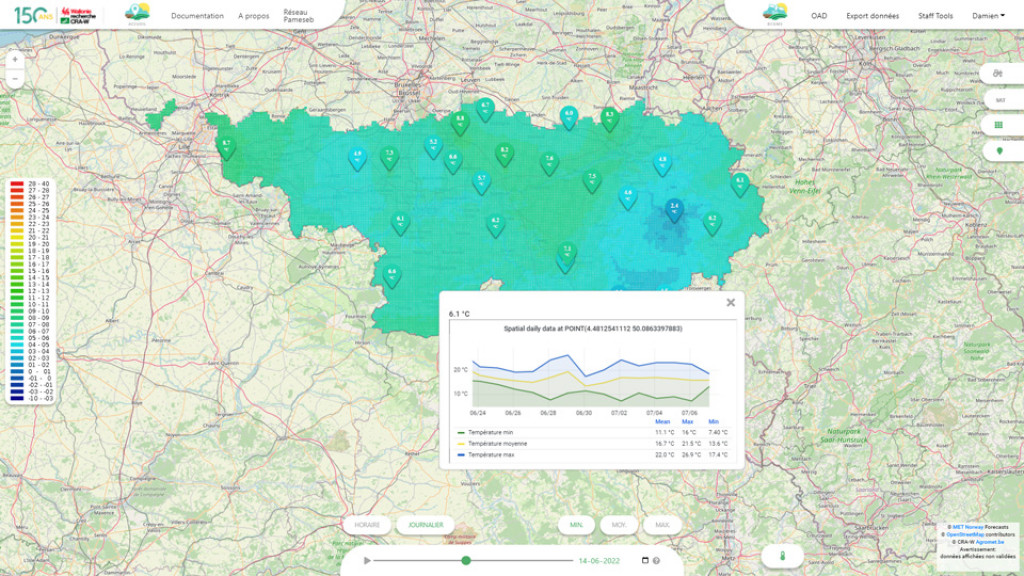
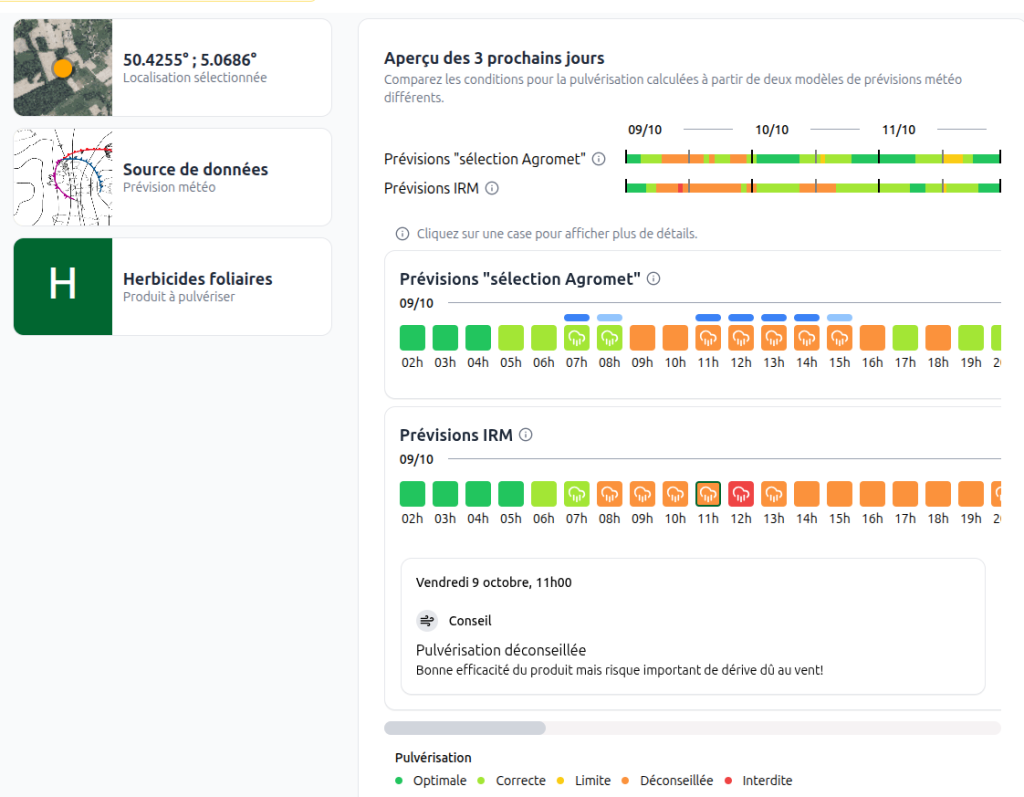
The SprayVision tool is available free of charge on the Agromet.be platform. It displays the suitability of weather conditions for spraying over the next three days and provides detailed recommendations if the user selects a specific time.
How the tool works
The user specifies the location of their plot by clicking on an interactive map and then selects the product category they wish to spray. Five product categories are available: foliar herbicides, root herbicides, prosulfocarb-based herbicides, growth regulators, and fungicides/insecticides. For each category, different thresholds for weather variables are used to determine whether spraying conditions are optimal (dark green), acceptable (light green), borderline (yellow), not recommended (orange) or prohibited (red).
The tool allows users to compare the advice obtained from two different sources of weather forecasts: forecasts provided by the Royal Meteorological Institute (IRM) and forecasts selected by the CRA-W’s Agromet team and downloaded from open-meteo.com. Displaying these two data sources helps to manage the changeable and uncertain nature of weather forecasts. If both forecast models give similar advice, the user can act on it with a degree of confidence. However, if the two models give different spraying recommendations, it is not advisable to act on them, and it is better to check the tool again later.
Résults
More than 18,000 simulations have already been recorded on the SprayVision tool since its launch in 2023.
The tool is part of a process of continuous improvement. Currently, the main limitation is that the tool only takes rainfall into account for a given hour. When providing advice for that specific hour, it does not take into account rainfall that has occurred previously or rainfall expected in the future. It is up to the user to be mindful of this. For example, they should check that the soil already has sufficient moisture for root-acting products, or, conversely, check that no excessive rainfall is forecast in the hours following application.
It should also be noted that utilising the optimal spraying windows from a weather perspective does not exempt users from other good spraying practices: pressure adjustment, appropriate boom height, anti-drift nozzles, adherence to buffer zones, etc.
Partners
Protect’eau, CARAH, IRM
Funding
CRA-W


Team