

Cover crops protect and improve soils, recycle nutrients, optimise nitrogen management, limit leaching and promote carbon storage.
In Wallonia, as part of the European ClieNFarms project, nine farmers from Hesbaye and Condroz, supported by the CRA-W, have chosen cover crops as a lever to increase the climate neutrality of their farms, by reducing nitrogen requirements and increasing carbon sequestration in soils. The aim is to gain a better understanding of how to increase biomass, return more nutrients to the soil and optimise fertilisation of the following crop.
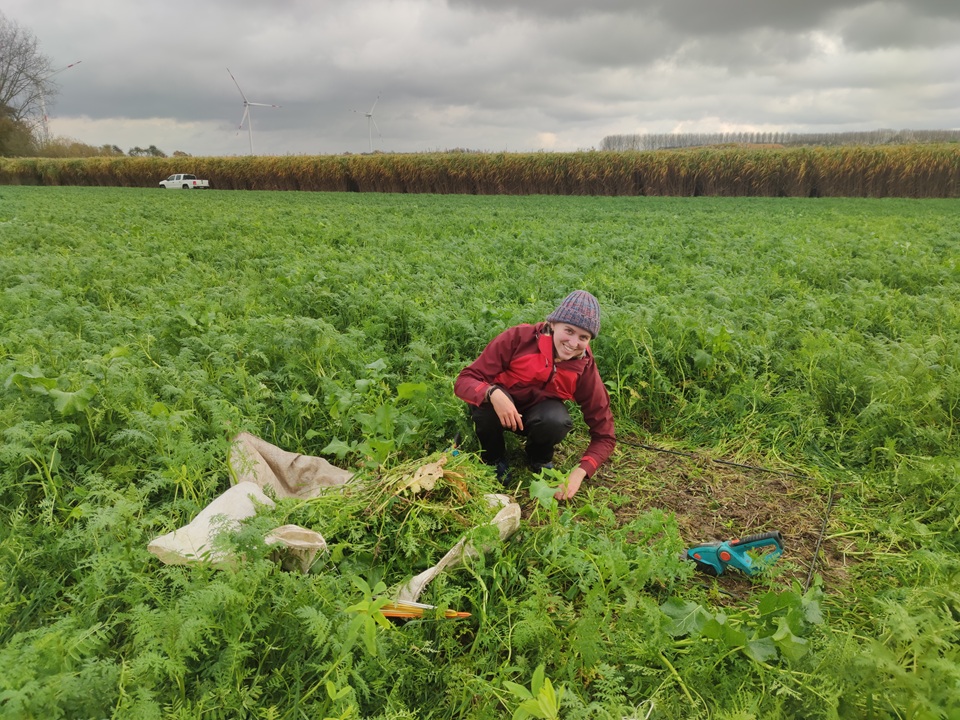
A total of 31 cover crops were tested in 2023 and 28 in 2024, mostly after winter cereals and before beet, potato or chicory. The amount of biomass varied significantly: Median of 1.4 t DM/ha in 2023 (0.23-5.37) and 2.3 t DM/ha in 2024 (0.77-3.73). The MERCI method (Méthode d'Estimation des Restitutions par les Cultures Intermédiaires, method for estimating yields from intermediate crops) was used to estimate N, P, K and stable carbon yields in order to adjust spring nitrogen fertilisation and, where appropriate, reduce inputs.
The project raised several points to consider:
– Choose species according to the previous crop, the following crop and the objectives;
– Check seed quality and carry out a germination test if necessary;
– Monitor slug pressure before sowing;
– Manage residues and regrowth of previous crops;
– Sow early and adapt planting to soil and weather conditions;
– Destroy the canopy at maturity for a good C/N ratio.
High-performance mixes include phacelia, niger, Egyptian clover, avena strigosa and a phacelia-clover duo that can achieve up to 4 t DM/ha when planted before 20/08. The relay cover, combining frost-sensitive species and frost-resistant legumes (crimson clover, hairy vetch), also proved effective in keeping the soil covered until spring before late crops.
A catalogue of solutions for making farms more climate neutral is available on the project website: https://clienfarms.eu/solutions/